
John Glushnik: | Tim, HG Ventures invested in INERATEC in 2024, because we could see the enormous potential of sustainable aviation fuels and other e-Fuels. But for those unfamiliar with this sector, perhaps you can help them level-set. Where do e-Fuels sit in the broader energy transition, and why do they matter right now? |
Tim Boeltken: | Many people think of the energy transition as electrification. But the real challenge isn’t just electrifying what we can, it’s removing fossil carbon from the system altogether. That’s what we mean by ‘defossilization’. The world is built out of molecules, and we cannot electrify everything. We will continue to electrify a lot of things, but there are hard-to-abate sectors that simply cannot be electrified directly. That’s where e-fuels and synthetic fuels come in. Aviation is the most obvious example, but we’re also looking at shipping, road transportation, and the chemical industry. What drives us every day is the idea that every gallon, every ton of fuel we produce is a ton where fossil fuel stays in the ground. |
John: | That’s a huge issue you’re tackling. Take us back to the early days; how did INERATEC come together, and what problem were you trying to solve when you started the company? |
Tim: | INERATEC was founded in 2016 as a spin-out from the Karlsruhe Institute of Technology, one of Europe’s leading universities in chemical engineering. Our core technology—compact, microstructured reactors—had been developed for more than two decades before we started the company. During our PhDs, our funding partners basically told us: ‘You can’t keep doing R&D forever. You need to bring this technology into industry.’ So we did. What surprised us was how quickly the market responded. Within the first year, we sold our first plant to a customer in Finland. We didn’t even really know how to send an invoice yet! From day one, we weren’t focused on telling the best story to investors. We were focused on where the market was, how we could bring the technology into real use, and how to get customer proof points early. |
John: | One thing that stood out to us early on was your modular approach. Please describe why that is so important? |
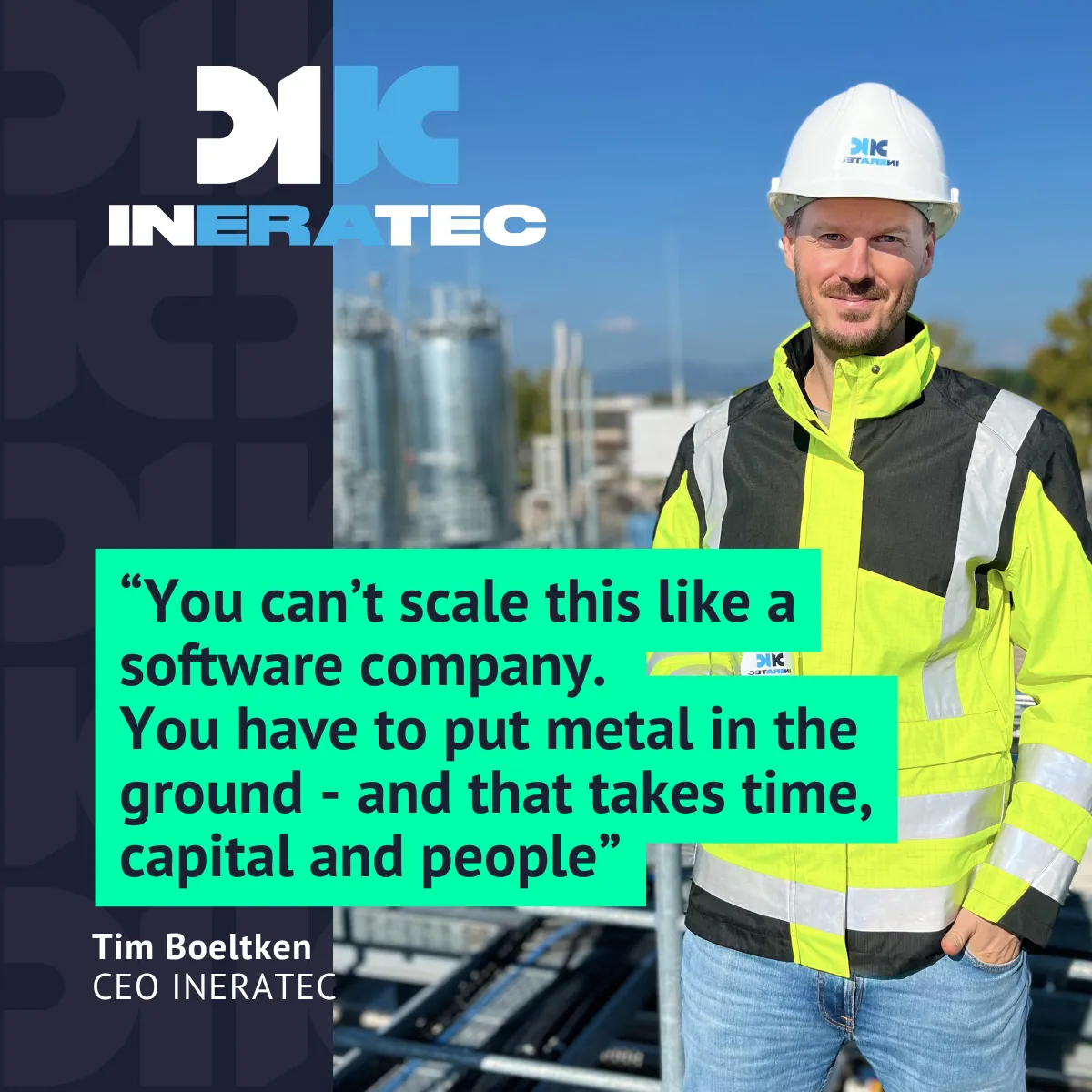
Tim: | If you look at renewables over the last 30 years, everything is modular: solar panels, wind turbines, batteries, electrolyzers. But chemical plants still look like they did 100 years ago. We use well-known chemical reactions, but we rethink how they’re processed. By intensifying those reactions in compact, modular systems, we can build much faster and scale incrementally. It’s not about what could be possible with 20 billion euros in ten years. It’s about what we can build now, how we can improve now, and how we can put steel in the ground. |
John: | Yes, and speaking of ‘steel in the ground’, let’s talk about the ERA ONE plant. What does it represent for INERATEC, and for the industry? |
Tim: | ERA ONE is our first commercial-scale production plant, and it’s a major milestone. From development to operation, it took a little over two years. In the chemical industry, that’s extremely fast. We started operating the first modules in June 2025 and delivered our first product shortly after. That’s the proof point. People want to see plants running, not shiny slides. We built ERA ONE to demonstrate and de-risk the technology. Even though we were confident in our modular approach, this is still a conservative industry. Seeing a plant operate over time matters. Now that box is checked. The future is about scaling into as many projects as possible, either as a producer, a core investor, or an OEM supplying our technology globally. |
John: | You chose not to rely on a single EPC (engineering, procurement, and construction contractor) to build ERA ONE. What did you learn from that decision? |
Tim: | A lot! We decided against using one major EPC because our technology is very innovative, and we didn’t want to spend time educating someone else on the full scope of what we were doing. That made execution more complex. Contract management and site management were difficult, and we had to build internal capabilities we didn’t have before. But the upside is huge. Today, we don’t just bring technology, we bring execution experience. That’s becoming a real differentiator as partners approach us for larger projects. |
John: | What advice would you give to other founders building hardware-heavy, infrastructure-intensive companies? |
Tim: | One big topic is insourcing versus outsourcing. Outsourcing can save cost, but you often lose control over quality. We insourced critical steps like electrical engineering and reactor manufacturing. Whenever we faced delays in Frankfurt, it was almost always related to third-party contractors. If ERA ONE had failed on quality, that would have been unacceptable. Keeping key capabilities in-house gave us confidence and control. And you have to be prepared for uncertainty. While you’re executing, people will question your decisions constantly. That’s why having patient, aligned investors matters so much. |
John: | That brings us to partnerships. What do you look for in investors and board members? |
Tim: | Strategic alignment and an understanding of the system, not just the market. Different perspectives are important, but you need people who understand how these industries actually work. With HG Ventures, the relationship is trustful and respectful. Discussions can be tough, but that’s a good thing, a sign of a strong partnership. You learn from them. Governance was also a learning curve for us, especially coming from a German GmbH structure. But once we embraced board-level strategic discussions, it became a strength. You get clarity, alignment, and shared responsibility. |
John: | Looking ahead, where do you see INERATEC in five to ten years? |
Tim: | We want to be the leading producer of e-fuels and synthetic fuels globally, in a much larger market than today. Climate change isn’t going away, but we also see strong demand driven by energy resilience and security, especially in Europe. Interest is growing not just from airlines and chemical companies, but also from defense and infrastructure players. We don’t just have one shot on goal—we have several. With every plant we build, we strengthen our position. The next project will be significantly larger than ERA ONE. It will require more capital, a larger team, and strong partnerships. But we’re hungry to do it again—bigger this time. |