
GtL
Gas-to-Liquid
Gas-to-Liquid (GtL) is a process in which synthesis gas—consisting primarily of hydrogen and carbon monoxide—is converted into liquid hydrocarbons. The resulting products can be used as synthetic fuels or feedstocks for the chemical industry.
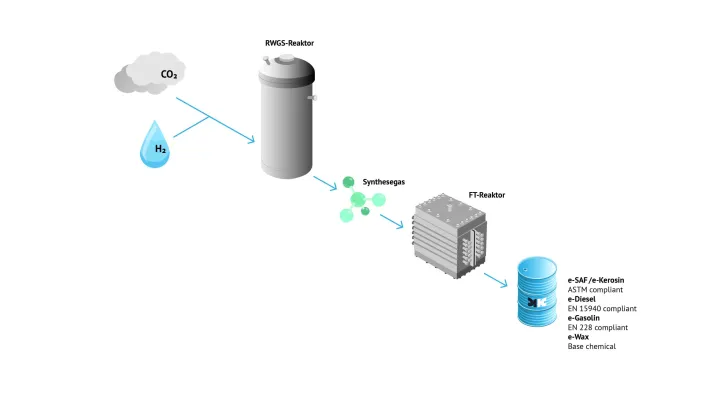
How does the GtL process work?
Synthesis gas production: The feedstock is synthesis gas, which typically consists of hydrogen and carbon monoxide. Depending on the project, it can come from biogenic sources, industrial processes, or Power-to-X applications.
Fischer-Tropsch synthesis: The synthesis gas undergoes a catalytic reaction in a reactor. This produces synthetic hydrocarbons, particularly liquid products and waxes.
Processing and use: The products are further processed depending on the intended application and can serve as a basis for synthetic fuels, chemical feedstocks, or specialty products.
GtL at a Glance

Properties of GtL Fuels
GtL products are characterized by high purity and consistent quality. Because they are produced synthetically, their properties can be specifically tailored. Of particular importance are the low levels of undesirable impurities, good processability, and suitability for applications that require liquid, storable, and transportable energy sources or raw materials.
Applications of Gas-to-Liquid
Synthetic Fuels: GtL products can be used as a basis for high-quality liquid energy carriers.
Chemical Industry: Fischer-Tropsch waxes and other hydrocarbons can serve as sustainable raw materials and intermediates.
Industrial Site Concepts: GtL plants can be deployed where suitable sources of synthesis gas are available and liquid products are to be produced directly on-site.
Power-to-X value creation: In combination with renewable hydrogen and CO₂-based process chains, GtL supports the production of decarbonized molecules.

From the Process to the Plant
INERATEC designs and builds modular GtL plants that efficiently convert synthesis gas into liquid products. Thanks to the modular plant design, the type and size of the plant can be tailored to each specific project. This allows plants to be configured, combined, and expanded to meet the exact needs of each location. For technical specifications, plant sizes, and reference designs, see Plants GtL.