
The EU regulation on sustainable aviation fuels
ReFuelEU Aviation
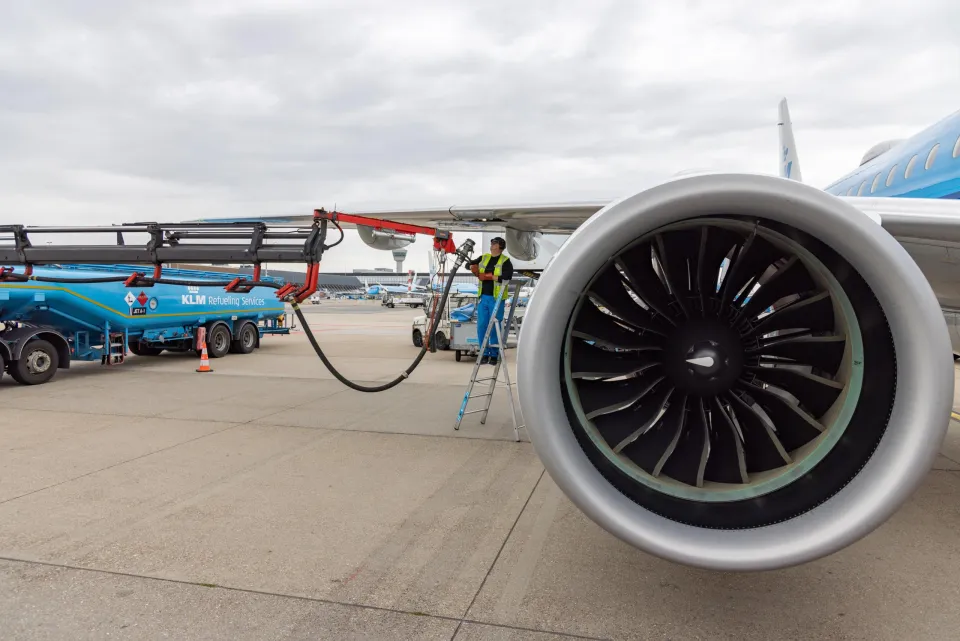
ReFuelEU Aviation is a key component of European climate policy for aviation. The regulation obliges fuel suppliers to gradually increase the proportion of sustainable aviation fuels (SAF) at European airports. Of particular relevance to the roll-out of e-fuels: from 2030, a separate minimum quota will also apply to synthetic aviation fuels such as e-SAF.
What is ReFuelEU Aviation?
Aviation is one of the sectors where reducing greenhouse gas emissions is particularly challenging. Aircraft require energy sources with a high energy density; at the same time, fleets remain in service for long periods and are subject to stringent technical and safety requirements.
Sustainable aviation fuels can play an important role here. They make it possible to reduce the climate impact of aviation whilst building on significant parts of the existing infrastructure and aircraft technology.
With ReFuelEU Aviation, the European Union is establishing a common regulatory framework for this. The regulation forms part of the European ‘Fit for 55’ package and was made binding by Regulation (EU) 2023/2405. At its heart is a gradually increasing quota for Sustainable Aviation Fuels. Fuel suppliers at EU airports covered by the regulations must provide an increasing minimum proportion of sustainable aviation fuels.
ReFuelEU Aviation goes a significant step further: in addition to the general SAF quota, the regulation stipulates a separate minimum share for synthetic aviation fuels from 2030 onwards. In doing so, the EU is creating a regulatory framework for a fuel category that is currently only at the very beginning of its industrial ramp-up.
What are Sustainable Aviation Fuels?
Sustainable Aviation Fuel, or SAF for short, is an umbrella term for alternative aviation fuels that, under the conditions laid down by the regulations, can help reduce greenhouse gas emissions from aviation. Under ReFuelEU Aviation, this may include various approved fuel pathways, such as advanced biofuels and synthetic aviation fuels.
It is therefore important to distinguish between SAF and e-SAF:
SAF refers to the overarching category of sustainable aviation fuels.
e-SAF refers to synthetically produced aviation fuel that can be manufactured using renewable energy. In this context, the terms ‘power-to-liquid’ (PtL) fuels or synthetic aviation fuels are also frequently used.
This distinction is crucial for ReFuelEU Aviation. This is because the EU not only stipulates an increasing overall quota for sustainable aviation fuels, but also sets aside a specific minimum share for synthetic fuels within this quota.
What SAF quotas does ReFuelEU Aviation stipulate?
ReFuelEU Aviation provides for a minimum share of sustainable aviation fuels that will increase over several decades.
The SAF quota will rise gradually:
- 2025: at least 2 per cent SAF
- 2030: at least 6 per cent SAF
- 2035: at least 20 per cent SAF
- 2040: at least 34 per cent SAF
- 2045: at least 42 per cent SAF
- 2050: at least 70 per cent SAF
This establishes a long-term regulatory pathway leading up to the middle of the century. The regulation also sets out a separate minimum quota for synthetic aviation fuels. This comes into effect in 2030 and rises significantly over the following decades. For the years 2030 and 2031, an average minimum share of synthetic aviation fuels of 1.2 per cent applies initially. In subsequent periods, this target will be further increased. By 2050, the minimum share of synthetic aviation fuels will ultimately stand at 35 per cent. The European approach is therefore not merely to gradually supplement or replace conventional kerosene with various sustainable alternatives. ReFuelEU Aviation specifically creates demand for synthetic aviation fuels.
Why is there a separate quota for synthetic aviation fuels?
Building a new fuel industry requires substantial investment. The production of e-SAF requires, amongst other things, renewable energy, hydrogen, suitable CO₂ sources, synthesis plants, further processing, certification, logistics and off-take agreements. Production facilities must be financed, built and commissioned before large quantities of synthetic fuels can become available. This is precisely where the synthetic sub-quota under ReFuelEU Aviation comes in.
By ensuring binding and gradually increasing demand over the long term, the regulation improves predictability for the market players involved. It creates a clearer regulatory framework for investment decisions for fuel producers, investors, airlines, airports and other companies along the value chain. The significance of ReFuelEU Aviation therefore extends beyond a mere blending requirement. The regulation is intended to help establish a European market for sustainable – and, in particular, synthetic – aviation fuels.
How is e-SAF produced?
Synthetic aviation fuel can be produced using so-called power-to-liquid processes. Put simply, hydrogen is first generated using renewable electricity. This hydrogen, together with carbon dioxide, can be used as a feedstock for the production of synthetic hydrocarbons. At INERATEC, this process combines technologies such as the reverse water-gas shift and Fischer-Tropsch synthesis, as well as downstream processing steps. In this way, synthetic hydrocarbons can be produced from hydrogen and CO₂ and further processed into various products, including components for synthetic aviation fuel.
The key advantage is that decarbonising aviation does not necessarily require the establishment of an entirely new energy source, complete with new global infrastructure. Synthetic fuels can be produced in such a way that they can be integrated into the existing fuel infrastructure whilst complying with the relevant technical and regulatory requirements. This characteristic is of particular importance in aviation.
What significance does ReFuelEU Aviation have for airlines?
ReFuelEU Aviation addresses not only the supply of SAF but also the behaviour of airlines when refuelling aircraft.
One key issue is what is known as ‘fuel tankering’. This involves an aircraft taking on more fuel at an airport than is actually required, for example, so that it needs to refuel less, or not at all, at another location. Such a practice could undermine the effectiveness of local SAF requirements and, due to the additional weight, also leads to higher fuel consumption.
The regulation therefore stipulates, as a general rule, that airlines must actually take on board at least 90 per cent of the fuel required at covered EU airports each year. The regulations provide for appropriate provisions or exemptions for specific operational situations.
This is intended to ensure that the increasing availability of sustainable fuels at European airports actually leads to their use.
What does ReFuelEU Aviation mean for fuel suppliers?
For fuel suppliers, ReFuelEU Aviation means one thing above all: the demand for SAF is not regulated as a short-term surge, but as a long-term increase in demand. There is a massive need for industrial scaling to meet the target of a SAF share ranging from 2 per cent in 2025 to 70 per cent in 2050. This applies in particular to synthetic aviation fuels.
Production capacities cannot be built up only once the relevant quota comes into force. Development, financing, engineering, construction, commissioning and certification of industrial plants all require lead time. The e-SAF quota scheduled for 2030 is therefore not only relevant for the year 2030 itself; it provides an impetus for investment and scaling up even before then.
Why is 2030 so important for e-SAF?
Whilst the general SAF quota came into effect as early as 2025, the mandatory quota for synthetic aviation fuels begins in 2030. This gives e-SAF a clearly defined role within European regulation. The initially comparatively small share should not, however, be viewed in isolation. The long-term development is crucial: the quota for synthetic fuels will rise significantly over the coming decades, reaching a minimum share of 35 per cent by 2050. For the European e-fuel industry, this means that production capacities, supply chains and facilities must be established and scaled up today in order to be able to supply the volumes required in the future.
What role does INERATEC play?
INERATEC develops and implements technologies and production facilities for synthetic fuels and chemicals. The focus is on converting renewable hydrogen and CO₂ into synthetic hydrocarbons. These can be used to manufacture various products, including feedstocks for e-SAF, e-diesel and other synthetic fuels and chemicals.
With facilities such as ERA ONE in Frankfurt, INERATEC is driving the industrial ramp-up of power-to-liquid production. ReFuelEU Aviation is of particular importance for this ramp-up. This is because technological scaling requires a market, and a new market requires reliable framework conditions. The rising European SAF quotas – and in particular the mandatory quota for synthetic aviation fuels – create a long-term outlook for this.
At the same time, regulation alone is not enough. To ensure that the planned volumes actually become available, production capacities must be built up, investment facilitated and suitable framework conditions created for renewable energy, hydrogen and CO₂.
What significance does ReFuelEU Aviation hold for the European e-fuel market?
ReFuelEU Aviation achieves something that is crucial for the industrial roll-out of new technologies: predictability on the demand side. For e-SAF, the synthetic sub-quota creates a demand defined by regulation. Companies can align production facilities and supply chains with a market whose minimum volume is determined by the rising quotas.
The actual bottleneck is thus increasingly shifting from the question of whether e-SAF is needed in European aviation to the question of how quickly sufficient production capacity can be built up. ReFuelEU Aviation is therefore far more than just a European fuel quota. The regulation is a key building block for establishing a new European value chain for sustainable and synthetic aviation fuels.
ReFuelEU Aviation in a nutshell